


17th 10,000km Field Survey - Accompanying
I accompanied the 10,000-kilometer field survey conducted by the Association for the Investigation of Specific Missing Persons, including on-site investigations at Ubara Beach in Katsuura, Chiba Prefecture, and Emiyoshiura in Kamogawa City, Chiba Prefecture.
The Reserve Blue Ribbon Association recreated the abduction methods used in the Hirasawaura incident in Tateyama City, Chiba Prefecture.
(1) Through on-site investigations, we will deepen our understanding of individual incidents and North Korea's abduction and espionage activities.
(2) To deter future espionage activities through public awareness campaigns.


Activity Log ■September 15, 2013, 09:00 Meet in front of "Ishii-so" in Onjuku Town, Chiba Prefecture
[In front of Ishii-so Inn, Onjuku, Chiba Prefecture]
On the night of December 15, 1978, the company of Mikio Uzawa, who would later become a designated missing person, held its year-end party at a guesthouse. This is the guesthouse where Mikio Uzawa, who was scheduled to stay the night, went missing (a different building from the one he stayed in at that time).
Later, someone who was night fishing near the embankment testified, "There was a person wandering around alone from the direction of the inn, and another person approached from the opposite direction, so I thought they were acquaintances. Before I knew it, they were both gone."
[Ubara Beach, Katsuura, Chiba Prefecture]
This is the location where the N Hospital in Tokyo, "Ubara Umi no Ie," which has ties to North Korea, used to be located.
At night, everyone leaves, and the coastline stretches out before you. The locations where buildings belonging to people connected to North Korea are situated share many common features.


[Emiyoshiura, Kamogawa City, Chiba Prefecture]
The participants on this day received an explanation in the convenience store parking lot in front of the N Hospital "K Experimental Farm" building.
Even now, local residents apparently find it "scary" to approach the area late at night. When asked what exactly they were "scared" of, they remained silent.
The coastline stretches out below the building. As expected, it's a secluded spot, and at night, no one can see you.
There are stairs on the breakwater directly below the building, allowing you to climb up to the building.
I don't know the circumstances under which it was created, but if an abduction were to be carried out, it would be an ideally designed environment.


[Tateyama City, Chiba Prefecture, Hirasawaura: Anti-crime case]
"Madam, we have some nice bolts of fabric on display at a reasonable price. Would you like to come and take a look?"
Alternatively, "The kimono shop where we worked went bankrupt, and we received bolts of fabric as compensation... would you be willing to buy them?"
They try to abduct you by saying things like, "The bolts of fabric are loaded in the car, so please get in and take a look."
Sakie Yokota, the mother of Megumi Yokota, was also approached in this manner after Megumi Yokota's disappearance.
Once you reach the car, they can easily push you in and drive away. There are probably people who have actually been abducted.
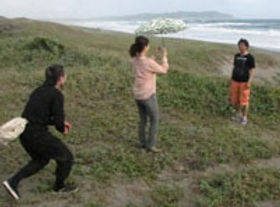


[Abduction method in Hirasawaura, Tateyama City, Chiba Prefecture]
As you walk along the coastline, people will call out to you, "Excuse me, could you take a picture of me with the ocean in the background?"
Who would imagine that an agent is closing in from behind while someone says, "I'm going to take a picture. Is that okay?"
They are easily taken down before they even have time to cry out. They are being choked, so there's no time to scream.
Then another person appears, gags him, restrains his hands and feet, and puts a bag over his head. All of this happens in just a few dozen seconds.


[Landing at Hirasawaura, Tateyama City, Chiba Prefecture]
The agents, approaching the Japanese coast in a small boat, land using rubber boats (right) or underwater scooters (left).
The photo above shows the actual item on display at the Japan Coast Guard Yokohama Museum.
As a precaution, one person approaches the shore first and lands. Secretary-General Yasuhiro Ito, acting as an operative, observes the surroundings. If there are no problems, he lands together with the other person.
Without prior information provided by the Japanese side, it would be difficult to avoid hidden reefs underwater, land safely, and operate in secrecy.
Another local guide is digging a hole to bury the scooter. After landing, we quickly hide the underwater scooter.
It wasn't something that happened over a long period of time like in a movie or TV show. It was an event that lasted only a few minutes.
In this situation, no one would know if underwater scooters or boats were buried.